Narrow Console Table Depth: Just Subtraction
· 9 min read
As an Amazon Associate we earn from qualifying purchases. We compare published specs and read what buyers say goes wrong. Links may earn us a commission, which never moves anything up a list.
Your corridor width sets the number, not the word "narrow"
Measure the corridor first. For hallways under 48 inches wide, ashdeco's console table guide puts the workable depth at 10 to 12 inches and calls 12 inches the hard maximum. So a narrow console is not a style category. It is an arithmetic result you can get to in thirty seconds with a tape measure.
Here is the subtraction. Take the corridor width wall to wall, subtract the walkway you intend to keep, and whatever is left is the deepest table you can put against that wall. Nothing else in the specification matters until that number exists.
That is the whole argument of this piece, and it matters because depth is the specification listings hide behind adjectives. Tribesigns names failing to measure depth as the leading console table buying mistake, producing cramped spaces. Run the subtraction and you can reject listings without reading them.
Worked numbers
A 44-inch corridor, minus a 36-inch walkway, leaves 8 inches. A 46-inch corridor leaves 10. At 48 inches you get 12, which is where ashdeco's ceiling sits.
The 36-inch figure is where sources part company. Ashdeco wants at least 36 inches of clear walking space on one side of the piece; Tribesigns accepts 30 to 36. Neither source explains the reasoning behind its clearance figure.
So the same 44-inch hallway supports an 8-inch table if you insist on 36 inches of clearance, or a 14-inch table if you accept 30 and accept that people will turn sideways. Pick which before you pick a product.
| Product | Product Dimensions | Item Weight | Color | Furniture Finish | Choose if you need |
|---|---|---|---|---|---|
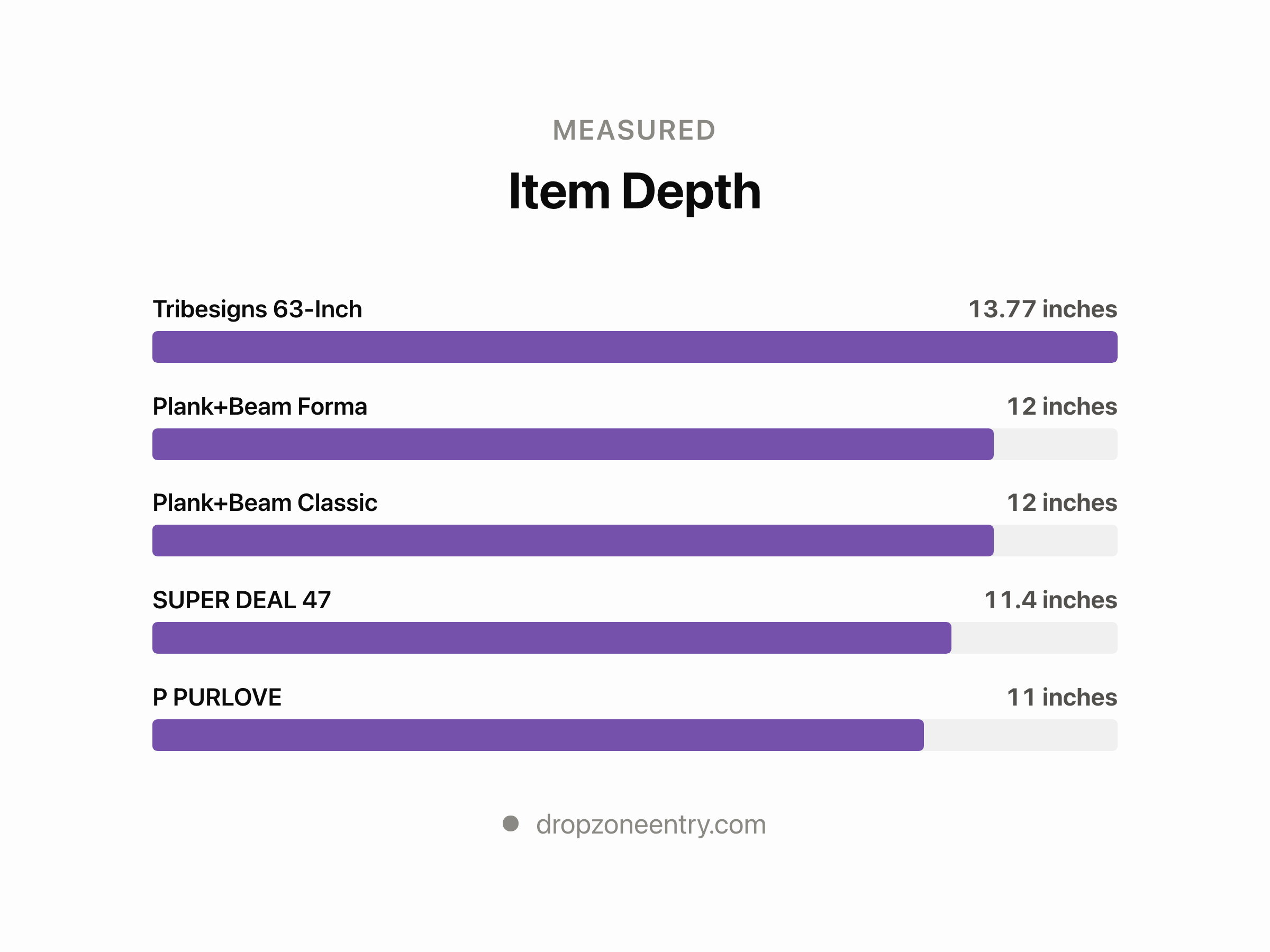
| Plank+Beam Forma | 12"D x 46.5"W x 32"H | 32.8 pounds | Pecan | Pine | Best solid wood |
| Narrow Console Table | — | — | — | — | Best lightweight |
| Tribesigns 63-Inch | 13.77"D x 63"W x 33.46"H | 24.5 kg | Natural (63") | Wood-like Veneer | Best long wall |
| Plank+Beam Classic | 12"D x 56"W x 32"H | 22.5 pounds | Blonde | Pine | Best narrow-and-long |
| DCLRN Console Table | 9.84 x 31.5 x 29.53 inches | 10 pounds | White | Alloy Steel | Best ultra-shallow |
| P PURLOVE | 11.1"D x 58"W x 34"H | — | Old Pine | Black | Best with drawers |
| SUPER DEAL 47 | 11.4"D x 47.2"W x 32.5"H | 36.8 pounds | Espresso | Espresso Finish | Best for charging |
Measurements come from the manufacturers. The “Choose if you need” call is ours.
The verdict
Narrow Console Table, best for you need a table for a very tight corridor or landing and want something light enough to lift and reposition on your own.
For everyone else:
- For you want a solid wood entryway table with a built-in lower shelf in a hallway where a 12-inch footprint is the hard limit: Plank+Beam Forma.
- For you have a long blank hallway wall or a full-size sofa back to fill and want one continuous surface rather than two small tables: Tribesigns 63-Inch.
- For you want the longest possible surface that still holds a strict 12-inch depth, in a traditional rather than industrial look: Plank+Beam Classic.
One caveat on the Narrow Console Table: shallow top will not hold a wide lamp base securely
Four retailers, one word, an eight-inch spread
Across these sources, "narrow" spans roughly 10 to 18 inches, which makes it weak as a filter. One seller's guide puts the typical narrow hallway table at 25–35 cm deep, roughly 10 to 14 inches, then widens the same claim elsewhere on the same page to 25–40 cm with about 30 cm as the most popular depth. Chris Loves Julia, writing about pieces behind a sofa, draws the line at under 12 inches. Tribesigns' own entryway guide says 12–18 inches is the practical range. Popmaison splits the category into three bands: 12–17 inches narrow, 18–24 standard, 25–36 wide.
So a 17-inch table falls inside Tribesigns' range and outside Chris Loves Julia's. Ashdeco defines the whole category as anything under 18 inches deep,
Where that bites is the market default. Ashdeco names 48 x 30 x 14 inches as the single most common console table size, and 14 inches is already over the 12-inch cap Ashdeco gives for a corridor under 48 inches wide.
Two more vocabulary traps. Tribesigns notes that "console table," "sofa table" and "entryway table" describe the same object, though Ashdeco does put sofa tables at 10–14 inches deep against 18–24 for a sideboard, so the label sometimes carries real information. And "hallway storage table" is a seller's term for a shallow piece with a shelf added, not a separate depth class.
Filter on the depth field in inches. Ignore the adjective in the title.
What has to be added back before you compare a listing against your maximum
The advertised depth may not be the depth of the object in your corridor. Ashdeco's guide puts the single most common size at 48 inches long by 30 tall by 14 deep, and that 14-inch figure is where most people stop reading. But no source in the evidence quantifies how much knobs, plinths or an open drawer add to it.
One allowance is documented:
- Manufacturing tolerance: 0.5 inch in length and depth on handmade pieces, per Artisan Born, and 1 to 2 inches on live-edge tops.
Tribesigns names failure to measure depth as the leading buying mistake, producing cramped spaces.
The depth floor
Popmaison's dimensions guide notes that pieces shallower than 12 inches are sold, and flags them as a tip-over risk. No standard sets the cutoff. No ASTM or CPSC stability figure for console tables appears in any of the sources consulted, so treat 12 inches as a working floor rather than a tested threshold.
So why does a 10-inch table need a wall anchor? Strictly speaking, the sources do not say. No source states at what depth-to-height ratio one of these becomes unstable, or how a lamp's weight shifts the centre of gravity relative to the footprint.
None of the sources consulted mention anti-tip hardware, anchoring, or any other mitigation, so there is no sourced guidance to offer here.
Popmaison also notes that pieces in the 12-to-16-inch band suit decor and small objects rather than storage. That is the honest ceiling on what a shallow top does.
Below twelve inches, a drawer stops being storage
Drawers need interior volume. No source gives interior drawer dimensions for a shallow piece, or the footprint of the objects a reader would want to put in one.
PopMaison's dimensions guide puts the practical line in the same place, describing 12-to-16-inch models as suited to decor, plants and small objects rather than storage, and reserving 18 to 24 inches for anything doing buffet duty. Ashdeco's guide separates the categories outright: a sofa table at 10 to 14 inches, a sideboard at 18 to 24.
So at 10 or 11 inches, the storage question is unresolved by the sources: none states a minimum depth at which a drawer stops being useful.
Behind a sofa is a different problem
Behind a sofa, the corridor arithmetic in the earlier sections does not apply. What governs the choice instead is height and length against the sofa itself. Ashdeco's placement guide says to match the sofa back height or sit 0–2 inches below it, never above; one seller's buying guide gives the range as 75–85 cm, level with or just under the backrest.
Measure your backrest before trusting any published height range.
Length is where the published advice splits. Chris Loves Julia says match the sofa or run a few inches shorter; Tribesigns says two-thirds to three-quarters, about 60–70 inches for a 90-inch sofa; Popmaison says one-half to two-thirds. The rules diverge widely, and none of the sources explains the reasoning behind its ratio, so none can be treated as settled.
One thing does carry over. If the sofa floats in the room, Chris Loves Julia notes the legs become the visible part, which is a reason to weigh leg design more heavily.
Plank+Beam Forma — Best solid wood
- Built from knot-free solid pine rather than MDF, so edges and legs are wood through
- 12 in. depth with a 46.5 in. length covers a long wall without narrowing the walkway
- But: At 32.8 lb it is the heaviest to carry up stairs or reposition alone
- But: One fixed lower shelf only, no drawer or closed storage
Narrow Console Table — Best lightweight
- Under 10 in. deep, the shallowest practical console depth
- Shorter 39 in. width fits between a door and a radiator
- But: Shallow top will not hold a wide lamp base securely
- But: Particleboard construction limits load on the top shelf
Tribesigns 63-Inch — Best long wall
- 63" length covers a long wall or the full back of a large sofa
- Roughly 90 kg maximum weight recommendation is the highest load rating here
- But: 13.77" depth is the deepest in this group — the wrong pick if your corridor is genuinely narrow
- But: MDF and melamine with a wood-like veneer, not solid timber
Plank+Beam Classic — Best narrow-and-long
- 56" of surface at only 12" deep — an unusually long-to-shallow ratio
- Solid knot-free pine with a non-toxic finish
- But: No shelf and no drawer — surface only, so clutter has nowhere to go
- But: 56" span with no lower stretcher shown means long unsupported reach across the top
DCLRN Console Table — Best ultra-shallow
- 9.8" depth is the shallowest here, leaving the most clearance to pass
- Three tiered open shelves stack storage vertically instead of outward
- But: 30 lb maximum capacity spread across a tiered metal frame
- But: 29.5" height is the lowest of these tables and may sit below a sofa back
P PURLOVE — Best with drawers
- Two pull-out drawers hide keys, remotes and mail behind a closed front
- 11.1" depth is among the slimmest here despite a 58" length
- But: 11 lb per drawer is a low ceiling — no tool stashes or stacks of books
- But: Wood frame and legs with an MDF top rather than solid wood throughout
SUPER DEAL 47 — Best for charging
- Three tiers at under 12 in. deep for baskets and shoes
- Anti-tip hardware included for wall fixing
- But: Bottom tier sits low, so floor cleaning around it is awkward
- But: Wood-effect finish is a laminate rather than veneer
Which of these seven fits which hallway
A 42-inch corridor with 32 inches of walkway leaves you 10 inches. Width, finish and storage are all downstream of that number.
Tribesigns' own material guide makes the relevant point: metal is what lets one of these be genuinely slim enough for a tight hallway.
The 11 to 12-inch band
No product-level specifications for tables in this band appear in the sources consulted, so no comparison can be made here. The only load figures in the sources are two manufacturer claims of up to 100 kg on 30 cm-deep models, given without test method or independent verification.
What this comparison is and is not
No buyer-side evidence surfaced in any source consulted: not one review, forum thread, complaint or return account. So every failure mode described above is a seller's or designer's prediction, not an owner's report.
So go back to the tape measure. Thirty seconds, wall to wall, minus the walkway you refuse to give up. If that number comes out at 10, you are at the shallow end of what the sources describe, where Popmaison flags a tip-over risk and reserves the shallowest pieces for decor rather than storage.
Questions
How deep should a console table be for a narrow hallway?
For hallways under 48 inches wide, ashdeco's guide puts the workable depth at 10 to 12 inches and treats 12 inches as the hard maximum. Derive your own figure instead: take the corridor width wall to wall and subtract the walkway you intend to keep. Whatever remains is your deepest possible table.
How much walkway space should I leave in front of a console table?
Sources disagree. Ashdeco wants at least 36 inches of clear walking space on one side of the piece; Tribesigns accepts 30 to 36 inches. Neither explains its reasoning. In a 44-inch hallway that difference means an 8-inch table at 36 inches of clearance, or 14 inches if you accept 30.
How narrow can a console table be?
Pieces shallower than 12 inches are sold, but Popmaison's dimensions guide flags them as a tip-over risk. No ASTM or CPSC stability figure for console tables appears in the sources consulted, so 12 inches is best treated as a working floor rather than a tested safety threshold.
What is a skinny entryway table called?
Console table, sofa table and entryway table all describe the same object, per Tribesigns. The labels sometimes carry real information though: ashdeco puts sofa tables at 10 to 14 inches deep against 18 to 24 for a sideboard. "Hallway storage table" is a seller's term for a shallow piece with a shelf.
How deep does a console table need to be to fit a drawer?
No source consulted states a minimum depth at which a drawer stops being useful, and none gives interior drawer dimensions for shallow pieces. Popmaison does describe 12-to-16-inch models as suited to decor, plants and small objects rather than storage, reserving 18 to 24 inches for buffet duty.
Sources
- Best Narrow Console Tables for Behind the Sofa, Slim Entryways, and Small Spaces - Chris Loves Julia accessed 2026-08-03
- Console Tables - Sofa Tables - Entryway Tables - IKEA accessed 2026-08-03
- Console Tables– Tagged "narrow hallway table"– Artisan Born accessed 2026-08-03
- What Is a Console Table? Sizes, Styles & Placement Guide accessed 2026-08-03
- What is The Length Of A Console Table? Console Table Dimensions-Tribesigns accessed 2026-08-03
- Console Table Dimensions: Common Width, Height and Depth accessed 2026-08-03
- Narrow Console Table: 2026 Buying Guide & Best Picks | Joybuy accessed 2026-08-03
- Popular Material Console Table Recommendations and Buying Guide-Tribesigns accessed 2026-08-03