Entryway Lighting Lumens: Why Targets Range 400 to 4,000
· 11 min read
As an Amazon Associate we earn from qualifying purchases. We compare published specs and read what buyers say goes wrong. Links may earn us a commission, which never moves anything up a list.
Four published figures, one 100-square-foot entry
You come in at 11pm, the porch bulb behind you, and you cannot tell which of the two similar keys is the deadbolt one. The ceiling fixture is on. It is not helping. Search for entryway lighting lumens and you will find four numbers for that same room, and they disagree widely.
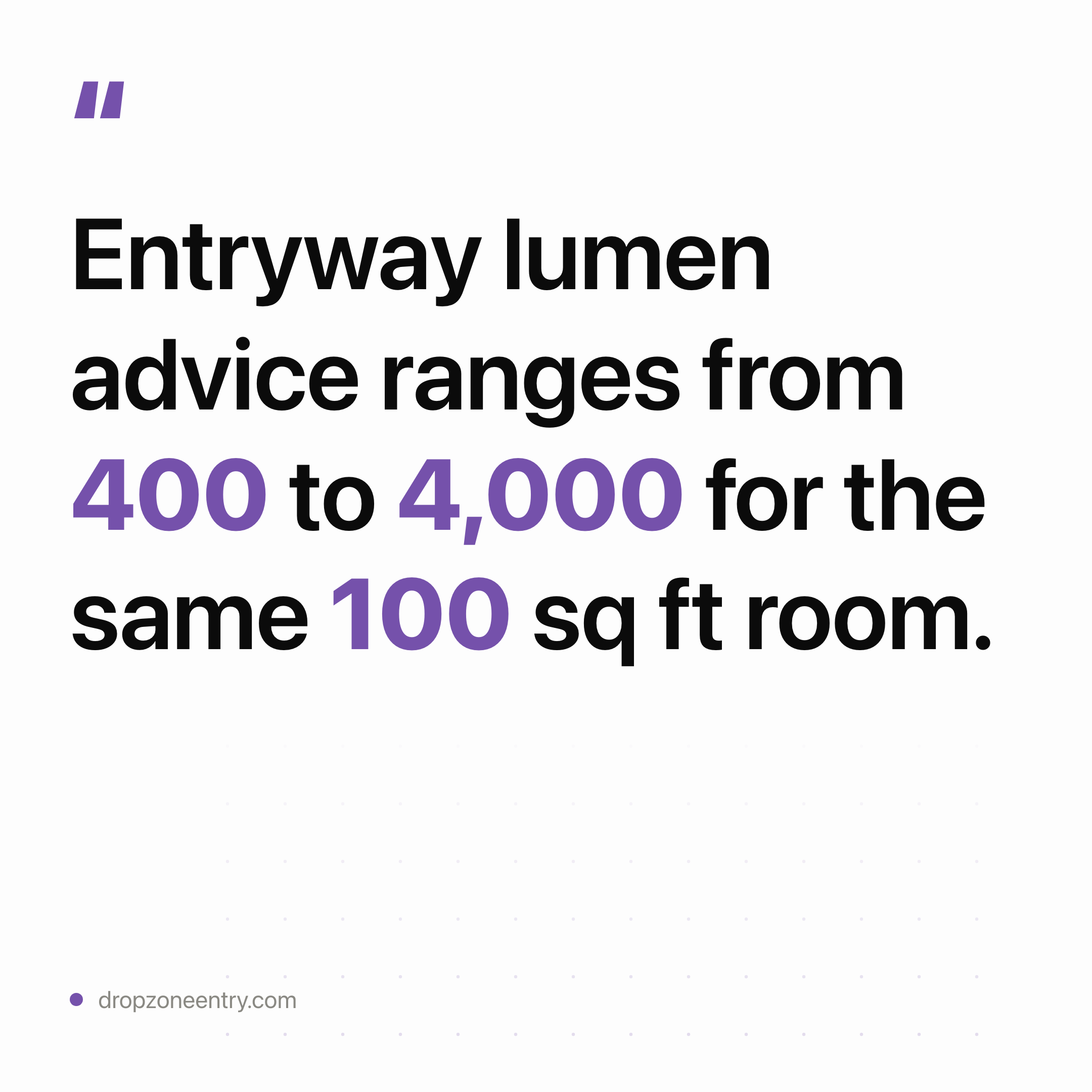
Published guidance, all of it retailer and publisher rules of thumb rather than any cited standard or code, runs from 400 lumens to 4,000. Residence Supply puts an entryway at 400 to 1,000 lumens total, adjusted for the room's size and ceiling height. MOD Lighting puts a foyer over 100 sq ft at 2,000 lumens or more, ideally with a second light source added. Golden Lighting targets 2,000 to 4,000 across layered foyer lighting. Space Daily's watt-based math lands a 100 sq ft room near 2,000 to 2,600.
None of the pages explains why the totals differ so widely: whether the low figures assume a small vestibule and the high ones a two-story foyer, whether they assume layered or single-fixture setups, or whether some are per-fixture and others whole-room. What follows is how to tell which figure describes your entry, and how to size a fixture to the task instead of to the room.
| Product | Size | Material | Item Weight | Light fixture form | Choose if you need |
|---|---|---|---|---|---|
| VICNIE | 12IN-2PK | Metal | 2.22 kg | Close to Ceiling | Best known output |
| OKELI White | 3 Pack | Aluminum | — | Close to Ceiling | Best multi-point coverage |
| WJShome 7-Light Lantern | 7-Light | Metal | — | Chandelier | Best high ceilings |
| Sunco 2 Pack | 2 Pack | Cold Rolled Sheet,Smooth Iron Wire | — | Close to Ceiling | Best wide spread |
| East Grove Home Cone | 10in Cone Shape | Aluminum | 1.8 pounds | Pendant | Best focused downlight |
| Airposta 16 | 16 inch | Metal | 0.92 kg | Ceiling | Best decorative accent |
Measurements come from the manufacturers. The “Choose if you need” call is ours.
The verdict
VICNIE, best for someone who wants a stated lumen figure they can plan around, since it publishes 1400 lumens at 20W in a 12-inch flush mount.
For everyone else:
- For a narrow hallway or landing where one ceiling box will not cover the whole path and light needs to be spread across several points: OKELI White.
- For a two-storey entry or stairwell with high ceilings, where a single flush fixture sits too far away to light the floor: WJShome 7-Light Lantern.
- For a wide entry or porch ceiling on one junction box, where two sockets spread light further than one: Sunco 2 Pack.
One caveat on the VICNIE: dimmer switch is not included, so the dimming range needs separate hardware
What each number assumes
Residence Supply gives 400 to 1,000 for an entryway, adjusted for size and ceiling height; it does not say what kind of entry that assumes. MOD Lighting's tiers scale to floor area, with the figure rising once the room passes 100 sq ft. Golden Lighting's 2,000 to 4,000 is a layered total, not one fixture: a chandelier plus sconces plus a lamp on the console. Space Daily's number comes from floor area alone.
Here is the part nobody says out loud. City Lights SF's room-by-room lumen table has no entryway row and no foyer row. The closest analogue City Lights SF offers is the hallway at 5 to 20 lm/sq ft, the lowest band in its table, below bedrooms and living rooms, which it rates at 10 to 20. Because no source gives an entryway figure in lumens per square foot, the flat totals cannot be reconciled against that table by arithmetic.
Where the 150-watt shortcut came from
Multiply the entry's square footage by 1.5 and you get watts, not lumens. Space Daily gives the shortcut that way: a 100 sq ft entry needs about 150 watts, which it converts to roughly 2,000 to 2,600 lumens of LED output. The arithmetic is fine. What it encodes is an incandescent bulb: Space Daily frames the 1.5 watts per square foot as an incandescent-equivalent total. LED packaging still lists a "replacement for X watt" claim alongside the lumen figure, which is how buyers match the brightness of an old incandescent. Space Daily is explicit that the shortcut is for quick planning only, since modern lamps are rated in lumens.
The conversion also leaves two things unstated. No source says whether its lumen target is bulb lumens or delivered fixture lumens, or how the total should be split between an overhead fixture and sconces.
What the shade takes
Space Daily notes that shades, frosted bulbs and lenses cut effective output, and that higher-lumen lamps or extra fixtures are needed to compensate. The size of that cut is what nobody publishes. No source quantifies the size of that cut for any fixture type.
Check total fixture lumens and per-bulb lumens separately, as Space Daily advises, because only the second scales.
How many lumens do you actually need to see a lock at night?
No source gives a foot-candle target for an entryway, and none converts between foot-candles and lumens for this room, so there is no published figure for how much light a lock takes. Fixtures are rated for total output; lumens measure a bulb or fixture's total light output, and what matters at the door is what survives the trip down.
Work it backwards. The VICNIE 12-inch flush mount is stated at 1400 lumens at 20W. What reaches a console below it is not published, and Space Daily notes that shades, frosted bulbs and lenses all reduce effective output without giving a figure for how much.
Now move the same fixture up.
The falloff nobody puts a figure on
No source quantifies how much light is lost as a fixture is mounted higher, or at what ceiling height a single ceiling-mounted fixture stops serving an entry. What the sources do change with height is the fixture and its drop. MOD Lighting recommends 10 to 12 inches of drop on 8-to-9-foot ceilings, 18 to 24 inches at 10 to 12 feet, and 5 to 7 feet of drop at 14 feet and above, always holding 7 feet of floor clearance. Space Daily puts the fixture bottom roughly level with the second-floor landing in a two-storey foyer. Both bring the source down as the ceiling rises.
Arriving dark-adapted, leaving into the dark
The entry is the transition between outdoor and indoor brightness, in both directions. None of the sources addresses exterior or porch-side lumens, or that transition at the door.
Residence Supply warns that entryway lighting can be too harsh and read as clinical, so brightness has to be balanced against comfort.
On colour temperature the sources agree: Space Daily specifies 2700K soft white for foyers and warns that 4100K or 6500K read brighter but can feel clinical in a home, while MOD Lighting and Golden Lighting both name 2700K to 3000K as the most welcoming range. No source gives guidance on what output to buy if a fixture will usually run dimmed. The Cone Advantage pendant dims to 5% on an ELV or TRIAC dimmer and takes a 100W E26 lamp.
Six fixtures against the same four criteria
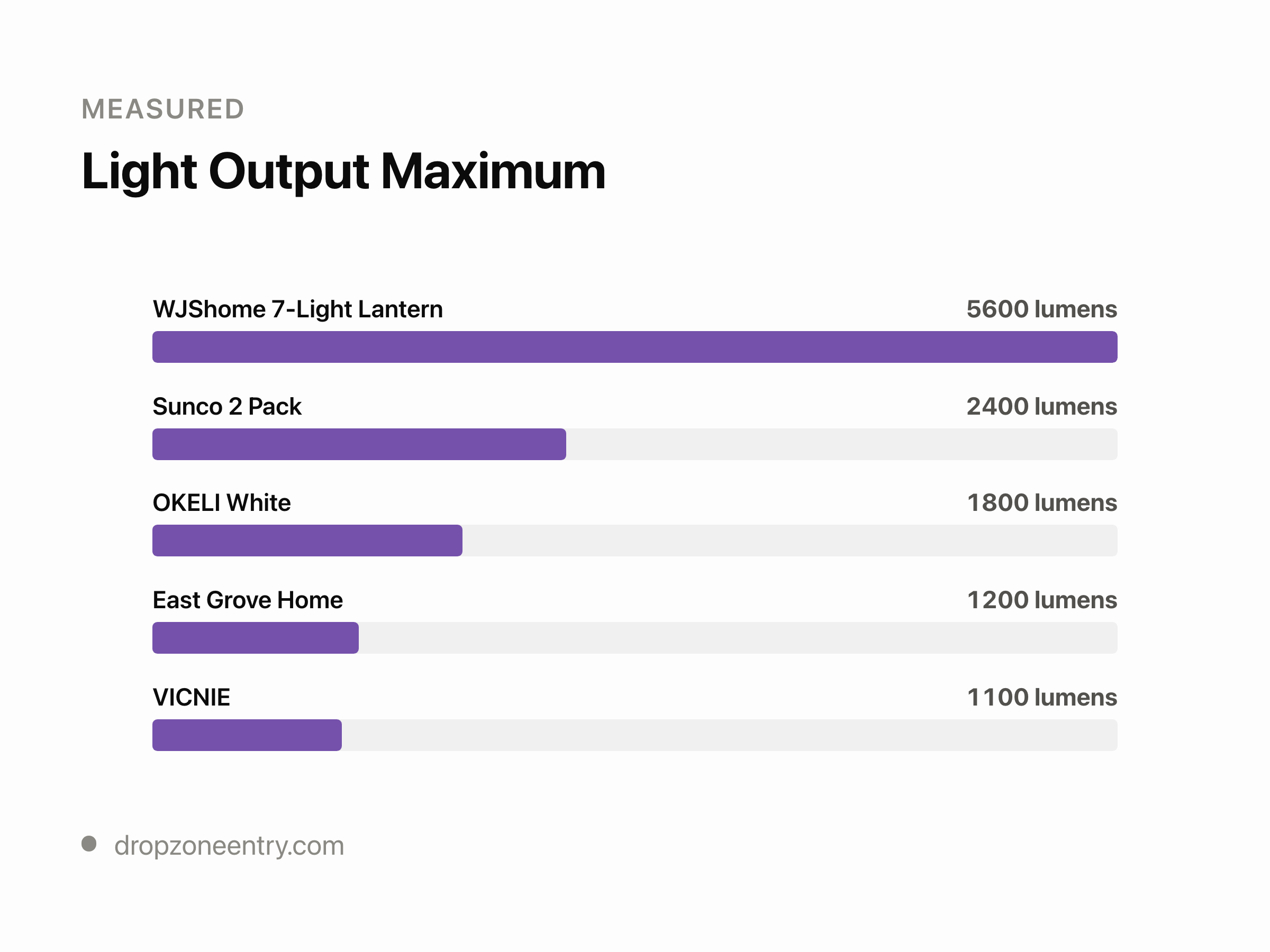
Two of the six publish a lumen figure. VICNIE's 12-inch flush mount states 20W drawing 1400 lumens, and OKELI states 1800 lumens per cylinder across a 3-pack. The other four ship bulbless, so their output is whatever you screw in, and their sockets cap what that can be.
Where the caps bite
- Airposta 16-inch star: a single E26 socket rated to 60W.
- WJShome 7-light lantern: seven E12 candelabra sockets, 60W maximum each.
- East Grove Home 10-inch cone: up to 100W on an E26, the highest ceiling of the six.
- Sunco 2-light flush mount: the load split across two E26 sockets in a 10-inch body.
An LED drawing 6 to 15 watts covers the 400-1,000 lumen range that would take an incandescent 30 to 75 watts, so a 60W socket cap does not by itself limit output to incandescent levels.
The diffusion penalty, fixture by fixture
Space Daily's foyer guide states plainly that shades, frosted bulbs and lenses cut effective output, so higher-lumen lamps or extra fixtures are needed to compensate. Nobody publishes the fraction. No source publishes the fraction for any fixture type, so a rated lumen figure cannot be corrected for a shaded fixture.
East Grove Home's cone dims to 5 per cent with an ELV or TRIAC dimmer. If your entry has the headroom for a hanging fixture, the Cone Advantage pendant is the one of these with a published dimming floor.
Airposta's perforated star throws patterned light; no output figure is published for it.
This comparison is built on published specifications and manufacturer statements. No fixture here was metered. Golden Lighting's own guidance, leave 6 to 12 inches between fixture and door top, is the one dimension you should check against your own entry door swing and traffic path before ordering anything that hangs.
Three checks at the drop spot
Stand where the keys land, the console top, the hook, the bowl, and hold a phone light meter flat on that surface. Door closed, porch light off, every other lamp in the entry off.
Two checks:
- Take a reading on the drop surface. City Lights SF notes foot-candles, a measure of light intensity per square foot, as the second metric buyers meet alongside lumens; no source publishes a foot-candle target for an entryway, so there is no threshold to check it against.
- Repeat with the entry's daylight blocked. Residence Supply's split is the reason: a windowless entry wants brighter, more reflective fixtures, a daylit one wants dimmable ones, and a midday reading tells you which you actually have.
Golden Lighting puts sconces at 60 to 66 inches off the floor, higher where ceilings exceed 10 feet. Worth checking before you buy a brighter fixture for the same spot. Then check the mail organizer slots your keys compete with on that same surface.
VICNIE — Best known output
- Publishes a specific output: 20W drawing 1400 lumens, so brightness can be checked against the entry's size before buying
- Selectable colour temperature across 3000K, 3500K, 4000K, 5000K and 6500K
- But: Dimmer switch is not included, so the dimming range needs separate hardware
- But: Listing claims both CRI 90+ and CRI 80+ in the same bullet, so colour accuracy is not clearly stated
OKELI White — Best multi-point coverage
- Sold as a 3-pack, so 1800 lumens each can be distributed along a hall rather than concentrated in one spot
- Narrow 4.6 in wide by 4.3 in high cylinder suits tight ceilings and low-clearance entries
- But: Colour temperature has to be preset before installation, so changing it means taking the fixture down
- But: Needs a dimmer switch bought separately
WJShome 7-Light Lantern — Best high ceilings
- Seven E12 sockets spread across different heights, so total output is set by how bright a bulb you choose in each
- Adjustable height for stairwell and double-height foyer drops
- But: No bulbs included and no lumen figure given, so output is entirely down to what you fit
- But: 60W maximum per E12 candelabra bulb limits the brightest options
Sunco 2 Pack — Best wide spread
- Two E26 sockets in a 10 in fixture, so you can double the lumens without a second ceiling box
- Sold as a 2-pack for a hall plus entry, or an entry plus mudroom
- But: No bulbs included and no lumen rating published
- But: Open steel cage leaves bulbs visible, so frosted lamps are needed to avoid glare
East Grove Home Cone — Best focused downlight
- White gloss interior on the cone reflects light downward instead of scattering it into the room
- E26 socket rated to 100W max, so it accepts higher-output lamps than most candelabra fixtures
- But: No lamp included and no lumen figure, so brightness is entirely on the bulb you buy
- But: A 10 in cone throws a tight pool, not general room light — poor as a sole entry fixture
Airposta 16 — Best decorative accent
- UL-listed E26 socket, so lumens and colour temperature are set by whichever bulb you fit
- Mounts as a ceiling light, wall lamp or vanity light from one fixture
- But: Single socket capped at 60W, so total output is limited for a large or dark entry
- But: No bulb included and no lumen figure published
Which of these suits which entry
Standard 8-foot ceiling, one junction box, and you want the number settled before you buy: the VICNIE 12-inch flush mount is the one that publishes an output figure, 1400 lumens at 20W, so you can check it against your entry before it arrives.
A hallway or landing that runs long is a different problem. The OKELI cylinders are sold three to a box at 1800 lumens each.
One box but a wide entry? The Sunco 2-pack puts two E26 sockets in a 10-inch body, so you set the total by bulb choice. No lumen rating is published for it.
High ceilings change the fixture. Space Daily says a 10-foot ceiling commonly takes a 20-to-30-inch-tall fixture and wants at least 7 feet 6 inches of clear height in 9-to-12-foot ceilings. The WJShome 7-light lantern has seven E12 sockets capped at 60W each.
Four numbers, one room. Pick by ceiling height and box count, then buy the bulb to the lock, not the room.
Questions
How many lumens for an entryway?
Published targets range from 400 to 1,000 lumens for a small entry up to 2,000 to 4,000 for a foyer over 100 square feet. The spread exists because low figures describe a single fixture in a vestibule while high figures are layered totals across a chandelier, sconces and a console lamp.
Why do entryway lumen recommendations vary so much?
None of the sources states its assumptions. Some totals are per-fixture, others layered across three light sources; some scale with floor area, others with ceiling height. No source specifies bulb lumens versus delivered fixture lumens, so a 400-lumen figure and a 4,000-lumen figure can describe the same room.
Is 4000 lumens too bright for an entry?
It can read clinical. 4,000 lumens is the top of a layered foyer range, meant to be split across several fixtures rather than one. Warm 2700K to 3000K output is the recommended range for entries, and a dimmable fixture matters more than raw output if the entry gets daylight.
Sources
- What Type of Light is Best for an Entryway? – Residence Supply accessed 2026-08-05
- How Many Lumens for Ceiling Lights? Room-by-Room Guide accessed 2026-08-05
- How to Choose Entryway Lighting | MOD LIGHTING 30-Days Money-Back Guarantee accessed 2026-08-05
- What Type of Light is Best for an Entryway? – Residence Supply accessed 2026-08-05
- A Guide to Lighting for Entrance Foyers in 2026 – Golden Lighting accessed 2026-08-05
- Choosing Foyer Lighting: A Guide to Illuminating Your Entryway accessed 2026-08-05
- What Type of Light is Best for an Entryway? – Residence Supply accessed 2026-08-05