1 Entryway Bench Dimension Matters More Than the Rest
· 10 min read
As an Amazon Associate we earn from qualifying purchases. We compare published specs and read what buyers say goes wrong. Links may earn us a commission, which never moves anything up a list.
The best entryway bench for putting on shoes
Depth decides everything. You sit on an entryway bench, lean forward to tie a shoe, and slide off the front edge because the seat is twelve inches deep. Most guides treat entryway bench dimensions as a width-and-height problem, ranking benches by how many shoes fit underneath. The measurement that determines whether you stay seated while reaching your feet is front-to-back depth.
The FOLUBAN Entryway Bench wins this list on that single measurement. At 15.7 inches deep, it lands at the upper end of the 14-to-16-inch standard range that LOOMLAN's entryway bench guide identifies, giving an adult enough seated surface to lean forward without sliding. If you want cushioning at nearly the same depth, the Zihanhome 54" Upholstered Storage Bench is the runner-up at 15.6 inches, adding a high-resilience sponge top the FOLUBAN lacks.
This comparison draws on published specifications and dimensional analysis, not hands-on testing. I have not sat on any of these benches. What follows relies on manufacturer listings and the geometry of leaning forward to reach your feet.
Where these picks come from: drawn from published manufacturer specifications and what buyers report, compared on paper rather than in person.
| Product | Product Dimensions | Material | Item Weight | Frame Material | Choose if you need |
|---|---|---|---|---|---|
| Zihanhome 54" | 15.6"D x 45.3"W x 19.3"H | Poplar | 25 pounds | Poplar Wood | Best cushioned seat |
| AQIMUELE | 11.8"D x 47.2"W x 20.4"H | Wood | 32.6 pounds | Rubberwood | Best shoe capacity |
| SONGMICS Shoe Bench | 31.89 x 19.29 x 12.2 inches | Linen, High Resilience Sponge, Metal | 15.7 pounds | Metal | Best small-space fit |
| Mirightone | 17.9"D x 41.9"W x 29.5"H | MDF+Rubber Wood | 55.1 pounds | Rubberwood | Best with backrest |
| AV CONNECT Vintage | 13.98"D x 45.67"W x 19.29"H | Seagrass, Solid Acacia Wood | 18.5 pounds | Acacia | Best decorative |
| FOLUBAN Entryway Bench | 15.75 x 47.24 x 17.91 inches | Engineered Wood, Metal | 28 pounds | Metal | Best quick assembly |
| Nnewvante | 11.85"D x 33.46"W x 15.53"H | Bamboo | — | Bamboo | Best indoor-outdoor |
| Bellemave | 42.7 x 16 x 50.37 inches | Birch, Engineered Wood, Pine | — | Pine | Best vertical storage |
| MILCIL | 43.3"D x 13.8"W x 17.7"H | Faux Leather | — | Oak | Best heavy-duty |
| Wnutrees 47" | 10.8"D x 47.2"W x 15.7"H | Wood | 16.5 pounds | Wood | Best minimalist |
Measurements come from the manufacturers. The “Choose if you need” call is ours.
The verdict
FOLUBAN Entryway Bench, best for renters or anyone who wants a bench ready in minutes — assembles in a claimed 10 minutes with minimal hardware, and the industrial look pairs with most décor.
For everyone else:
- For you want a cushioned seat with shoe storage tucked underneath — the upholstered top and dedicated lower shelf handle both comfort and clutter in one piece: Zihanhome 54".
- For households with many pairs of shoes — three adjustable, removable tiers hold 15–18 pairs while the cushioned top provides a proper seat: AQIMUELE.
- For tight entryways where every inch counts — at just 31.9" wide, it fits beside a narrow front door while still offering two shoe shelves and a padded seat: SONGMICS Shoe Bench.
One caveat on the FOLUBAN Entryway Bench: 17.9" seat height is slightly lower than standard chair height; taller users may notice
Why 14 inches of depth fails the shoe-tying test
Every guide I have read repeats the same number. LOOMLAN's entryway bench guide puts standard depth at 14–16 inches; Cabinfield says 14–18. Both figures describe someone sitting upright with their hands in their lap. Nobody ties shoes in that position.
When you lean forward to reach your laces, your center of gravity shifts backward toward the rear edge of the seat and your thighs lose contact with the sitting surface, leaving almost no margin at 14 inches of depth before the whole posture becomes unstable. Your body compensates by bracing: one hand on the seat edge, the other fumbling with the shoe. By my estimate, hands-free shoe-tying needs roughly 15 to 17 inches of depth.
You can run this test on any bench before buying. Sit down, lean forward as if reaching for your laces, and lift both hands off the seat. If you tip backward or tense your core to hold position, the depth is too shallow for the task the bench exists to perform. In this analysis, fifteen inches is roughly where most adults stop bracing; seventeen is where the forward lean becomes stable without effort.
What a shoe shelf does to that number
Adding a storage tier underneath the seat forces the seat height upward, and most shelved benches in this category land between 19 and 21 inches. At those heights your thighs angle downward from hip to knee instead of resting level, which moves your center of gravity further back and shrinks the contact patch between your legs and the seat.
By my estimate, the penalty is roughly linear: for every inch of seat height above 18 inches, you need at least one additional inch of depth to keep the same seated stability. The AQIMUELE Shoe Bench pairs a 20.4-inch seat height with only 11.8 inches of depth. The SONGMICS Shoe Bench, at 19.3 inches high and 12.2 inches deep, follows the same pattern. Both store shoes well, but the shelf that holds them makes sitting down to tie them less stable.
How much hallway does a bench really consume?
Depth alone is misleading.
A bench against a wall occupies more floor than its listed dimensions suggest, because the person sitting on it extends forward. Start with the bench depth, add an estimated 10–12 inches for the feet and knees of someone leaning down to tie a shoe, then add the clearance a second person needs to walk past.
LOOMLAN's entryway guide puts that walking clearance at a minimum of 36 inches. Povison's storage-bench roundup confirms the same figure. In tight hallways, passage may be possible in as little as 30 inches, though both sources above set 36 inches as the recommended minimum.
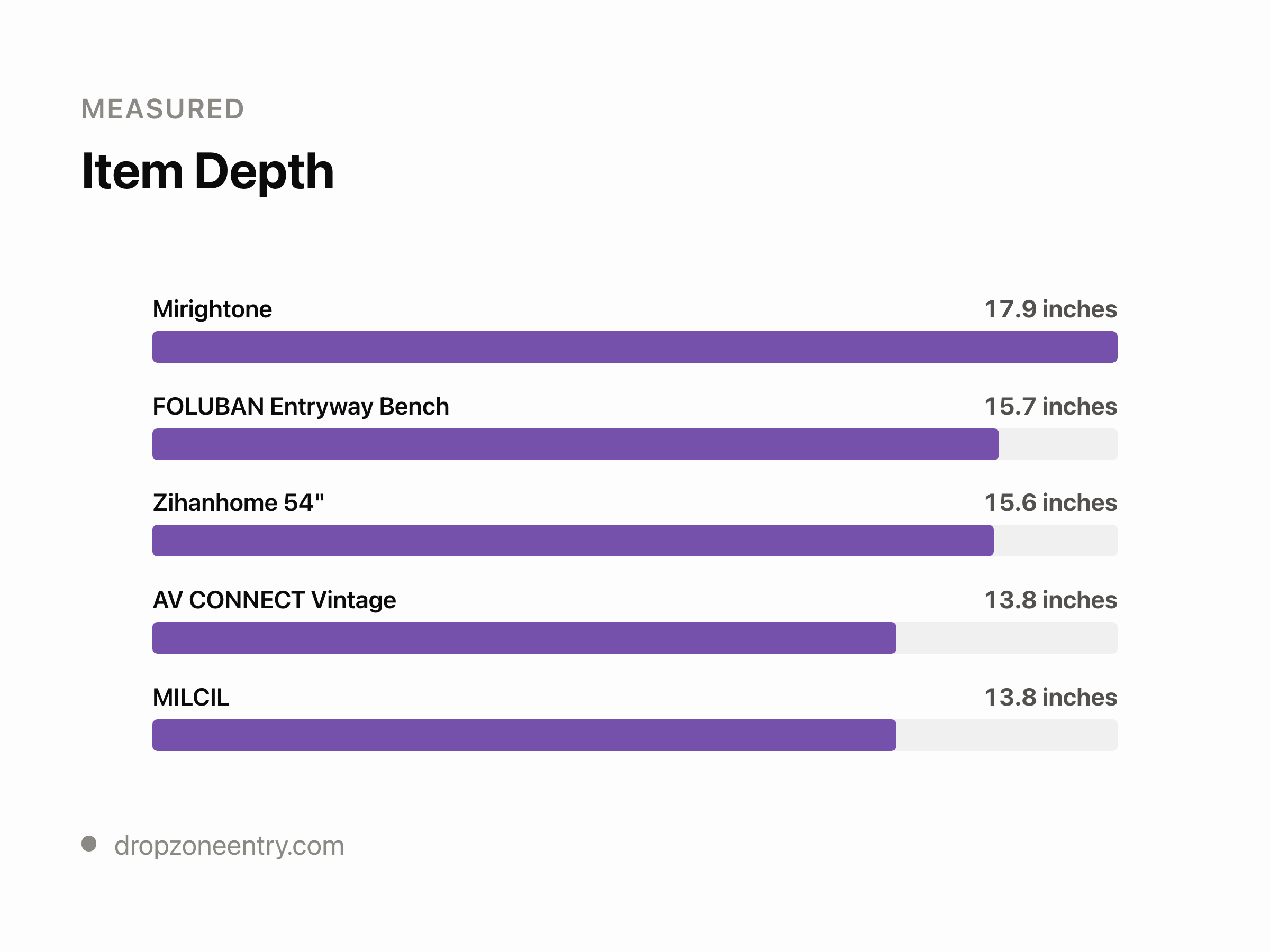
Run the numbers for a 16-inch-deep bench: 16 + 10–12 + 30–36 = 56–64 inches of total hallway width, wall to wall, for one person to sit and tie shoes while another walks past. A 12-inch bench like the Nnewvante bamboo model drops the total to 52–60 inches. The Mirightone backrest bench, at 17.9 inches deep, pushes the requirement to 58–66.
Many apartment entryways run roughly 48 to 60 inches wide. In a 48-inch hallway, any bench deeper than about 14 inches blocks passage the moment someone sits down. The bench fits the space. The person using it does not.
Hold a tape measure at the wall and mark 56 inches out before ordering. If that line crosses the opposite wall or cuts into a door swing, you need a shallower bench or a different location entirely.
Ten benches ranked by depth, height, and capacity
Numbers settle arguments.
I ranked these ten benches by how well their published dimensions serve the one task an entryway bench exists for: sitting down to tie shoes. Depth leads because it determines whether you can shift your weight back while bending forward. Seat height matters second; LOOMLAN's entryway bench guide recommends 250-plus pounds of capacity, and a seat near 18 inches keeps knees at a workable angle.
Width I weighted last: anything between 36 and 48 inches seats two and fits a standard entryway, per the same guide. The gap between the deepest and shallowest seat here is 7.1 inches, the difference between a seat and a shelf.
Top five for tying shoes
Mirightone Storage Bench with Backrest: 17.9" depth plus a full backrest at 29.5" overall height. The only bench here that lets you lean back while lacing up, which changes the ergonomics of bending forward entirely. The Storage Bench with Backrest weighs 55.1 lbs and spans 41.9" wide; its 250-lb seat capacity is the second-lowest in this group, so the backrest comes at a cost.
FOLUBAN Industrial Bench: 15.7" depth on a steel frame rated to 350 lbs, with a 17.9" seat height that puts most adults' thighs roughly parallel to the floor. No cushion and no backrest, but the widest uncushioned seated surface here. The FOLUBAN Entryway Bench claims 10-minute assembly, useful if you move often.
Zihanhome 54" Upholstered Bench: 15.6" depth with a cushioned top over a 300-lb poplar frame. At 45.3" wide it seats two adults side by side, and the open lower shelf keeps shoes visible. The Zihanhome 54" Entryway Bench uses cationic-linen fabric that cannot be removed for washing; poplar, a softer hardwood, dents more readily than the rubberwood or oak competitors use.
AV CONNECT Vintage Seagrass Bench: 13.98" depth over solid acacia rated to 330 lbs, with acacia's natural resistance to moisture. No cushion; the handwoven seagrass is firm and can snag rough fabrics. A decorative piece, not an ergonomic seat.
MILCIL Ottoman Bench: 13.8" depth but a 660-lb weight capacity on a solid oak frame, more than double any other pick here. The tufted faux-leather wipes clean and the CertiPUR-US certified foam adds comfort, though the narrow depth means perching rather than sitting back.
The remaining five
SONGMICS Shoe Bench: 12.2" deep, 31.9" wide, 300 lbs on powder-coated steel. Fits beside apartment doors where a full-width bench cannot. At 15.7 lbs it is the lightest option here and easy to reposition, but at that depth you balance on the front edge while you tie.
AQIMUELE 3-Tier Shoe Bench: 11.8" depth, yet the 20.4" seat height is the closest to standard chair height here, and the rubberwood frame holds 500 lbs. Three adjustable tiers store 15–18 pairs. The AQIMUELE Shoe Bench is a shoe rack that earned a cushion, not a bench that added shelves.
Bellemave 4-Door Storage Bench: 17.4" seat height with a washable cushion behind four cabinet doors. Hides clutter effectively, but 200 lbs capacity is the lowest here. The manufacturer does not list seat depth in its published specs, which tells you something about priorities.
Nnewvante Bamboo Bench: 11.85" deep, 15.53" tall. Too low for most adults to bend forward comfortably and reach their laces. Bamboo's moisture resistance suits a bathroom or covered porch where shoe-tying is secondary.
Wnutrees Farmhouse Bench: 10.8" deep, 15.7" tall. The shallowest and among the lowest seats in this set. Solid wood with saber legs. No storage. As a shoe-tying bench it asks you to crouch on a narrow ledge.
Which bench fits which entryway
A four-foot-wide apartment hallway leaves about 36 inches of passable width after the door swing. LOOMLAN's entryway guide recommends at least 36 inches of clearance for small entryways, which caps practical bench depth near 12 inches. The SONGMICS bench, at 31.9 inches wide and 12.2 deep, is the only pick here sized for that scenario.
Matching bench to space
For a wide mudroom with 8 feet or more of wall, the Mirightone storage bench earns its footprint: 17.9 inches deep with a full backrest, the sole option in this group that lets you lean back while lacing. Families cycling through children's shoes should consider the AQIMUELE three-tier bench, whose adjustable shelves hold 15 to 18 pairs and can be removed entirely to fit tall boots.
On a covered porch or in a bathroom, the Nnewvante bamboo bench handles moisture by material rather than by coating, though its 15.53-inch seat height works better for children than for adults reaching down to tie shoes. For shared apartments or heavy daily traffic, the MILCIL ottoman bench lists a 660-lb capacity on its oak frame, more than triple the 200-lb top rating on the Bellemave cabinet.
This ranking is built from published specifications and buyer-reported complaints, not from hands-on measurement. I did not sit on these benches. What you get is a comparison of what the manufacturers claim, cross-checked against what buyers say goes wrong.
Depth started this article, and depth finishes it. A bench that stores forty pairs of shoes but seats you on twelve inches of surface will send you sliding forward the moment you reach for a lace. Measure your hallway front to back before you measure it side to side.
Questions
How deep should an entryway bench be for tying shoes?
Most adults need 15 to 17 inches of seat depth to lean forward and tie shoes without sliding off the front edge. At 14 inches, the standard low end, your center of gravity shifts backward and you have to brace with one hand. Fifteen inches is roughly where hands-free shoe-tying becomes stable.
How much hallway space do you need in front of an entryway bench?
Add the bench depth, 10 to 12 inches for the seated person's knees and feet, and at least 30 to 36 inches of walking clearance. For a 16-inch-deep bench, that totals 56 to 64 inches wall to wall. Measure your hallway front to back before ordering.
What are the standard dimensions of an entryway bench?
Standard entryway benches run 14 to 18 inches deep, 17 to 20 inches tall, and 36 to 48 inches wide. Width in that range seats two adults and fits most entryways. Seat height near 18 inches keeps thighs roughly parallel to the floor for comfortable bending.
What bench dimensions work if you want shoe storage underneath?
A storage shelf raises the seat to 19 to 21 inches, which angles your thighs downward and reduces seated stability. For every inch of seat height above 18 inches, add roughly one inch of depth. A shelved bench at 20 inches tall needs at least 16 inches of depth for stable shoe-tying.
Sources
- Entryway Bench Guide: Sizes, Styles & Storage | LOOMLAN accessed 2026-08-03
- Do I Need an Entryway Bench? Here’s How to Decide - Cabinfield Blog Skip to content Menu About Cabinfield accessed 2026-08-03
- Best Entryway Benches with Storage 2026 accessed 2026-08-03