Coat Hook Height Is a Subtraction, Not a Standard
· 11 min read
As an Amazon Associate we earn from qualifying purchases. We compare published specs and read what buyers say goes wrong. Links may earn us a commission, which never moves anything up a list.
The subtraction that decides the height
Your longest coat drags. That is the whole problem. For a standard winter coat the answer is 60 inches: Ashdeco puts a 34 to 38-inch coat there specifically so it clears the baseboard, and a 28 to 32-inch blazer no lower than 55. Both are fine. The trouble starts one garment up.
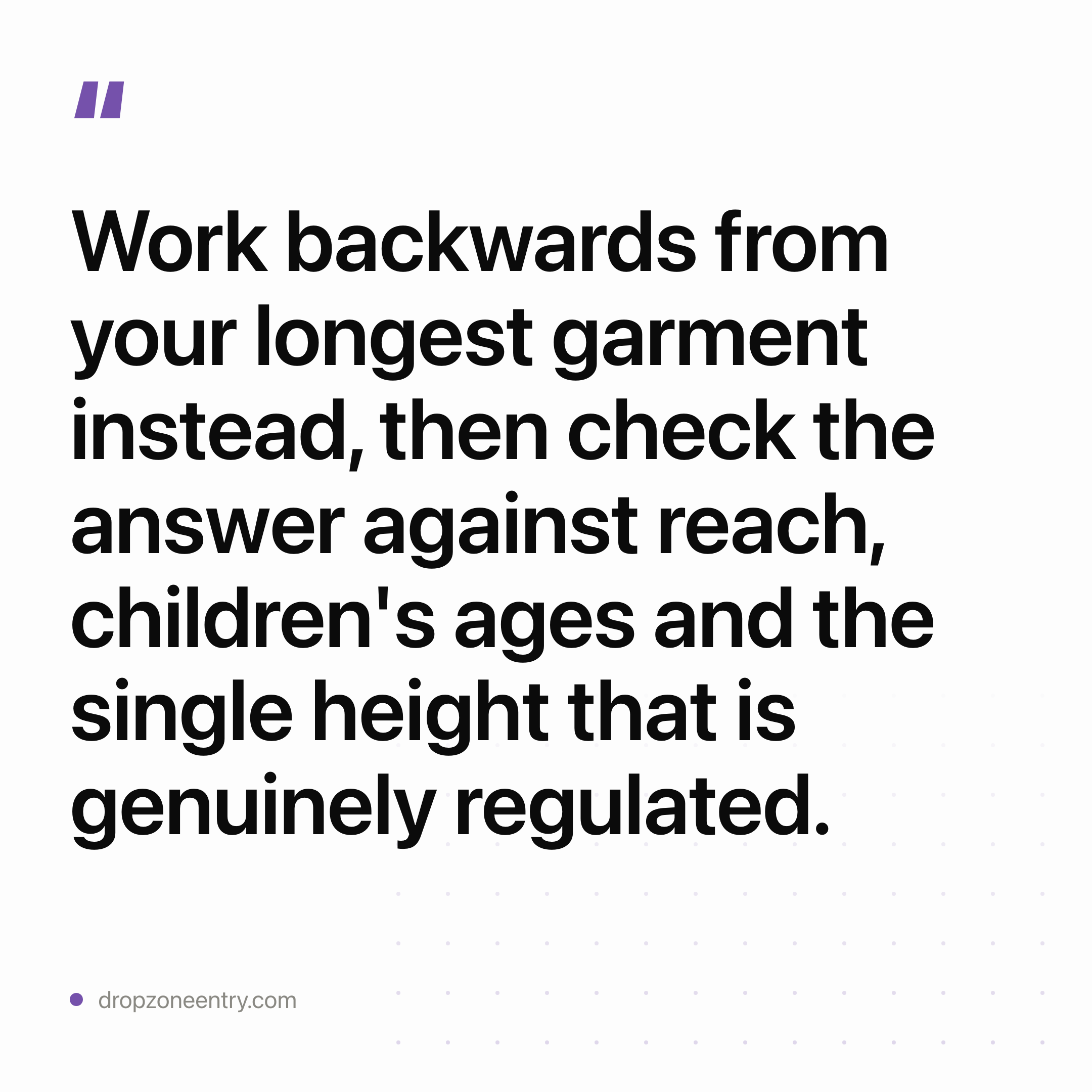
Height is a subtraction rather than a number. Measure the garment, add the drop from the hanging loop or hook curve, add the clearance you want above the floor, and the sum is your minimum. Work it the other way round and you get a wet hem.
This section is for anyone about to drill a hallway wall for a household that owns coats of very different lengths: a full-length wool coat and a child's anorak on the same run. Do the arithmetic first and you will know before you make a hole whether one row of hooks can serve everybody, or whether you need two.
Here is Ashdeco's formula, garment length plus 3 inches for hook hardware and hanger drop, kept under the hook-to-floor distance, worked three times. The 12-inch floor clearance below is a choice, not a published figure; Ashdeco's own worked example is a 42-inch coat at 60 inches, leaving about 18 inches of clearance.
Note what the third row does to the standard. A 52-inch overcoat on a hook at 60 inches leaves 5 inches of clearance once the loop is counted, near enough the floor to catch grit and a wet boot. Ashdeco reaches the same place by a different route, calling for 68 to 70 inches for a 50 to 55-inch coat, or a standing rack instead. OJCommerce goes further, recommending 70 to 72 inches for long coats and robes.
One more correction. Per OJCommerce, the target height refers to the top of the hook, not the backplate, so a curved hook with 2 to 3 inches of drop mounts higher than the number suggests.
| Product | Product Dimensions | Material | Item Weight | Color | Choose if you need |
|---|---|---|---|---|---|
| LARHN | — | Bamboo | — | Bamboo | Best two-height pairing |
| Vlush | 5.2"D x 10.2"W x 37.8"H | Cast Iron | 2.2 pounds | Black | Best vertical spread |
| ROOREVO | 24 x 3.4 x 2.3 inches | Metal | — | White | Best for busy families |
| Dseap | 16.93 x 4.53 x 3.15 inches | Aluminum | 16 ounces | Bronze | Best for long coats |
| susswiff 10-Pack | 0.51 x 0.51 x 3.7 inches | Metal | 4 ounces | Black | Best free placement |
| Wehhbtye 2Pcs Adjustable | 7.5 x 0.99 x 2 inches | Metal | 9.12 ounces | 4pcs | Best no-drill option |
Measurements come from the manufacturers. The “Choose if you need” call is ours.
The verdict
LARHN, best for mounting one rail at adult height and a second at child height in the same hallway, since the pack contains two identical 16.5-inch racks.
For everyone else:
- For covering a range of coat lengths and user heights from a single fixing point, because its hooks climb a 37.8-inch vertical column instead of sitting in one horizontal row: Vlush.
- For a wide entryway wall where a whole family needs its own hook at a comfortable single height, and two rails can be run end to end or stacked: ROOREVO.
- For long, heavy overcoats that need to hang away from the wall without creasing or slipping off the hook: Dseap.
One caveat on the LARHN: 16.5 inches long with 5 hooks, so spacing is tight for bulky winter coats hung side by side
Is there a standard height for coat hooks?
No accessibility standard sets a height for an ordinary coat hook. Rethink Access, an accessibility consultancy, states plainly that nothing in the standards specifies or requires a mounting height for a standard, non-accessible fitting. The numbers you keep reading are convention. They carry no compliance weight at all.
That matters because the figures do not agree with each other. Ashdeco puts the adult range at 60 to 65 inches, measured from the floor to the centre of the hook. OJCommerce gives 60 to 72 inches and names 66 inches the "standard builder height". Ashdeco's own buying guide, separately, says 60 to 66. Same category, three ceilings.
Rethink Access derives its own figure from shoulder-to-eye human dimensions, landing at 60 to 66 inches, or 1520 to 1680 mm. No source gives a derivation for the 60 to 65 or 66-inch figures, so it is only a guess that the 66-inch builder figure is the top of that same band; the phrase appears in one source, with no stated origin. OJCommerce's 72-inch upper bound is not explained either, though the same source recommends 70 to 72 inches for long coats.
Where the most-cited guide is silent
Wirecutter's coat rack testing never measured mounting height. Wall-mounted racks were installed on a plywood board, not at a specified height on a wall. The most-cited buyer's guide in the category supports no height figure whatsoever.
Which leaves you with stature, not standards. Ashdeco pitches the 60 to 65 inch band at people between 5'4" and 6'0". Over six feet, it recommends 65 to 70 inches to stop you stooping. Under 5'4", no source gives a figure. Ashdeco's own advice is to fit the household by measuring its tallest and shortest regular users.
Take the band as an offset from your own shoulder, then check it against the longest coat you own.
What ADA §603.4 actually says, and the half everyone drops
Rethink Access, a Texas registered accessibility specialist firm, states that the code requires an accessible hook to fall inside a reach range: 48 inches (1220 mm) maximum and 15 inches (380 mm) minimum above the finished floor. That is a floor as well as a ceiling. On that reading a fitting at 12 inches would fail the code as one at 54 inches does. No source states where that requirement is legally binding, whether it reaches residential entryways or only covered public and commercial facilities.
Three exemptions that get dropped
- Coat hooks are not required in accessible toilet rooms or stalls at all.
- Where they are provided, at least one must comply. A second one need not.
- Fittings inside non-accessible stalls are exempt from the accessible height entirely, which means a compliant room can hold them at more than one height.
Rethink Access says accessible hooks are in practice usually set at 44 inches (1115 mm), measured to the centerline of the unit rather than to the top or tip. No source explains why practice sits below the maximum. Ashdeco gives 40 to 48 inches (102 to 122 cm) as comfortable forward reach from a chair for seated users generally, and 44 sits mid-band.
The European figure is lower, and it addresses something the U.S. one ignores
Axeuro, a French sanitaryware manufacturer, sets the top of hooks for people with reduced mobility at 110 cm, about 43.3 inches, and more than 40 cm from a corner. The height lands within an inch of the 44-inch U.S. practice figure and roughly 5 inches below the 48-inch maximum. No U.S. source in this comparison gives an equivalent corner clearance for accessible fittings, though OJCommerce gives 6 inches from a corner for an end hook generally. Note the disagreement underneath: the same manufacturer cites the French Decree of 20 April 2017, Article 4, as banding public manual control devices between 0.90 m and 1.30 m high and requiring more than 0.40 m from an internal corner or other obstacle. That is a materially different band from the U.S. 48-inch maximum.
Two rows on one wall: the mixed-use layout
Two rows, not one compromise.
A mixed-use entry has two incompatible numbers to satisfy. The accessible height is 44 inches to the centerline. The conventional adult height sits at 60 to 65 inches. Both can live on the same wall, and the only real constraint is what the upper coat does on its way down.
No source addresses how to satisfy both figures in one installation beyond installing two rows, and none states whether a single compliant fitting plus a higher convenience one is acceptable in a home. As a matter of arithmetic, a full-length wool overcoat hung at 62 inches would hang past anything set at 44 inches. Ashdeco's 16-inch spacing figure for bulky winter coats is a horizontal gap, not a published separation between rows.
Sources disagree on the lower number, and the disagreement matters. Ashdeco puts the second row at 36 to 42 inches; OJCommerce gives a flat 42 inches for a child row against 66 inches for adults. Neither is the accessible figure. If the row exists for a wheelchair user rather than a six-year-old, 44 inches is the one to hold.
One more clearance: OJCommerce says the end hook should sit at least 6 inches off a corner. Two staggered rows eat wall fast, and corners are where people run out.
Children's hooks by age, not by a single band
A single 36 to 42 inch children's band covers a four-year-old and an eleven-year-old identically. The sources do not agree on the range either. Ashdeco puts ages 5 to 11 at 36 to 42 inches; OJCommerce widens it to 36 to 48 inches for ages 3 to 10.
HangSafe Hooks runs higher than both, and measures to the top of the rack rather than the hook: 42.7 inches for ages 3 to 5, 49 inches for 5 to 7, 53 inches for 7 to 9. At 9 and over it gives 60.9 inches, adult height in practice.
The same French manufacturer goes the other way, putting the top of hooks for children over 7 at 90 cm, roughly 35 inches. That is well below the figures the U.S. sources give for comparable ages.
The progression I would drill to
Ashdeco's toddler figure is 24 to 30 inches for ages 2 to 4, and it attaches a condition worth keeping: lightweight items only. Then 36 to 42 for primary school. Then 54 to 58 inches for ages 12 to 17, where Ashdeco also suggests adjustable fittings.
Reach alone is the trap. A four-year-old can touch a hook at 30 inches, but a coat long enough relative to that height will leave its hem near the floor, which is presumably why Ashdeco's toddler band carries the lightweight-items-only condition. Subtract the garment first, then check reach. Same arithmetic as before.
So install two rows now. One at the current age, one at the upper end of Ashdeco's 54 to 58 inch teen band for later. The lower row becomes bag storage when it is outgrown.
Six checks before you drill
Ashdeco's guide drops robe hooks behind a door to 60 to 62 inches, because higher risks the robe catching on the door frame when the door opens. The calculated number loses to physics, and it loses in six predictable ways.
Door swing arc. Mark where the open door's edge lands before you mark the fitting. Behind-door robe hooks come down to 60 to 62 inches per Ashdeco.
Stud position on hollow walls. Get one screw into a stud. Between studs, OJCommerce's guide calls for heavy-duty toggle bolts rated to 50 lbs or more. No source addresses plaster, brick or tile, or what to do when the stud does not fall where you want it.
Load by room. Ashdeco puts mudroom per-hook expectations at 30 lbs and up, against 15 to 25 lbs for an entryway and up to 10 lbs for light-duty bedroom fittings. No source connects these ratings to mounting height.
Corridor width. In hallways narrower than 40 inches, Ashdeco puts hooks at 62 inches or higher.
Which rack fits which height problem
None of the six solves every case.
Judge them on the criteria already set out: clearance for your longest garment, whether one purchase gives you two heights, stated load, and projection off the wall.
Two heights from one purchase. A single multi-row rack can set two heights at once. Wirecutter describes Room & Board's Crew as 38 inches wide and 8 inches tall, with eight accessory hooks on top and four coat hooks below, so one mounting decision fixes both. Owners report the metal edges are sharp enough that it is not recommended for delicate fabrics such as a silk scarf. Buyers who cannot fit a 38-inch rack can mount single or triple versions of the same design instead, and use as many as the wall allows.
A band rather than a height. The Eames Hang-It-All is 14¾ inches tall with 14 knobs across tiers, so it occupies a vertical band rather than a single height. Published single-number heights do not describe it.
So what actually makes things slip?
Geometry, not height. In Wirecutter's testing, pegs sticking straight out perpendicular to the wall risk things sliding off, unlike upward-angled ones. Deeply bent arms let owners layer several items per peg and never let anything slip in testing, a capacity gain with nothing to do with mounting height. A single row limits how much a rack holds regardless of where it goes.
Freestanding, if you would rather not decide. OJCommerce says most freestanding racks are 68 to 72 inches tall with the top hook already at about 66 to 70 inches and need no installation; Ashdeco puts standing racks at 60 to 75 inches tall overall. A standing rack needs at least 36 inches of path width in front of it and 12 inches of clearance above.
Everything above comes from published specifications and buyer reports, not from anything I hung on a wall.
Back to the dragging coat. Measure it, add the drop, add your clearance, then check the answer against the 60 to 66-inch band that OJCommerce gives for adult wall-mounted hooks. If the sum lands higher than 66, Ashdeco's advice for the longest coats is 68 to 70 inches or a standing rack instead, and OJCommerce gives 70 to 72 inches for long coats and robes. If your answer differs for every person in the house, individually placed fittings let you set each height separately.
Questions
Is there a standard height for coat hooks?
No standard sets a height for an ordinary coat hook — the figures circulating are convention with no compliance weight, and they disagree. Published adult ranges run 60 to 65 inches, 60 to 66 inches, and 60 to 72 inches, with 66 inches sometimes called the builder height. Measure from floor to hook centre.
What is the ADA height for a coat hook?
An accessible hook must fall within a reach range of 15 inches minimum and 48 inches maximum above the finished floor, so a fitting mounted too low fails as surely as one too high. In practice accessible hooks are usually set at 44 inches, measured to the unit's centerline.
How high should coat hooks be for children?
By age, not one band: roughly 24 to 30 inches for ages 2 to 4 and lightweight items only, 36 to 42 inches for primary school, and 54 to 58 inches for ages 12 to 17. Some sources widen the middle band to 36 to 48 inches. Check the coat length, not just reach.
Sources
- Coat Hook Height: Exact Measurements for Every Room & User accessed 2026-08-03
- What height should safety coat hooks be installed? - HangSafe Hooks accessed 2026-08-03
- How High Should a Coat Rack Be from the Floor? Expert Guide & Tips accessed 2026-08-03
- Street Address accessed 2026-08-03
- Installation heights - Coat hooks | PRM Standards accessed 2026-08-03
- Coat Racks to Declutter Your Entryway in 2026 | Reviews by Wirecutter Advertisement accessed 2026-08-03
- Coat Rack Buying Guide 2026: Types, Sizes, Cost & How to Choose accessed 2026-08-03
- How High Should a Coat Rack Be from the Floor? Expert Guide & Tips accessed 2026-08-03