Coat Closet Rod Height: What Installers Actually Set
· 12 min read
As an Amazon Associate we earn from qualifying purchases. We compare published specs and read what buyers say goes wrong. Links may earn us a commission, which never moves anything up a list.
The 66-inch figure and what contractors actually install
A rod set at 66 inches is meant to let long coats hang without brushing the floor. Then try lifting a bin of hats onto the shelf above it. That second move is what decides coat closet rod height, and almost no guide mentions it.
Contractors set single rods at 68 to 72 inches rather than 66. Homeaglow puts the standard at roughly 66 inches from the floor to the center of the rod; Bob Vila also gives 66 inches, though measured to the bottom of the rod. Bob Vila's version, updated 29 October 2024 and credited to Manasa Reddigari and Bob Vila, explains it as the height that lets long coats, dresses and suits hang without brushing the floor. Contractors on a Fine Homebuilding thread from 1 August 2005 give different numbers entirely. One sets every single rod at 70 inches, calling 68 too low and 72 too high. Another caps his at 68 because anything higher makes it awkward to slide a box onto the shelf above.
That disagreement is the whole point. One contractor's stated limit is shelf-loading reach rather than coat length, and a third installer in that thread inverts the problem completely: he sets the shelf at 64 to 66 inches so the occupant can actually see what is stored on it, which drops the rod a couple of inches below.
The trade positions are narrow: 70 inches from one contractor, 68 from another who cites loading a box onto the shelf above.
| Product | Product Dimensions | Material | Item Weight | Color | Choose if you need |
|---|---|---|---|---|---|
| ABtool Closet Rod | 1"L x 1"W | Stainless Steel | 1.03 kg | Black | Best permanent install |
| XIIW Pull Down | 33.07"L x 48"W | Stainless Steel | 6.31 kg | Black | Best high reach |
| Idefair | 17"L x 5"W | Metal | 1.3 kg | 1 Pack | Best custom sizing |
| FOTRIC | 4"L x 17"W | Stainless Steel | 1.44 kg | Silver/2 Pack | Best for two tiers |
| Deco Brothers | 35.5"L x 30.5"W | Alloy Steel | 2.2 pounds | Chrome | Best for renters |
| Yeetburg | 33"L x 30"W | Stainless Steel | 0.74 kg | Chrome | Best hook-hung |
| Luvenia | 28.7"L x 29"W | Stainless Steel | 0.32 kg | 1 Pack Black | Best for kids |
| INFLATION | 1"L x 25"W | Metal | 0.25 kg | Black | Best narrow closet |
Measurements come from the manufacturers. The “Choose if you need” call is ours.
The verdict
ABtool Closet Rod, best for setting the primary coat rod at a permanent, measured height across a wide reach-in closet, since it wall-mounts on brackets rather than hanging from an existing bar.
For everyone else:
- For a coat closet with a tall ceiling where the rod would otherwise sit above comfortable reach, because the whole rail pulls down to you: XIIW Pull Down.
- For an awkwardly wide or oddly sized coat closet where you need to fine-tune both the hanging height and the span with no preset stops: Idefair.
- For splitting one deep coat closet into an adult upper tier and a child-height lower tier at the same time: FOTRIC.
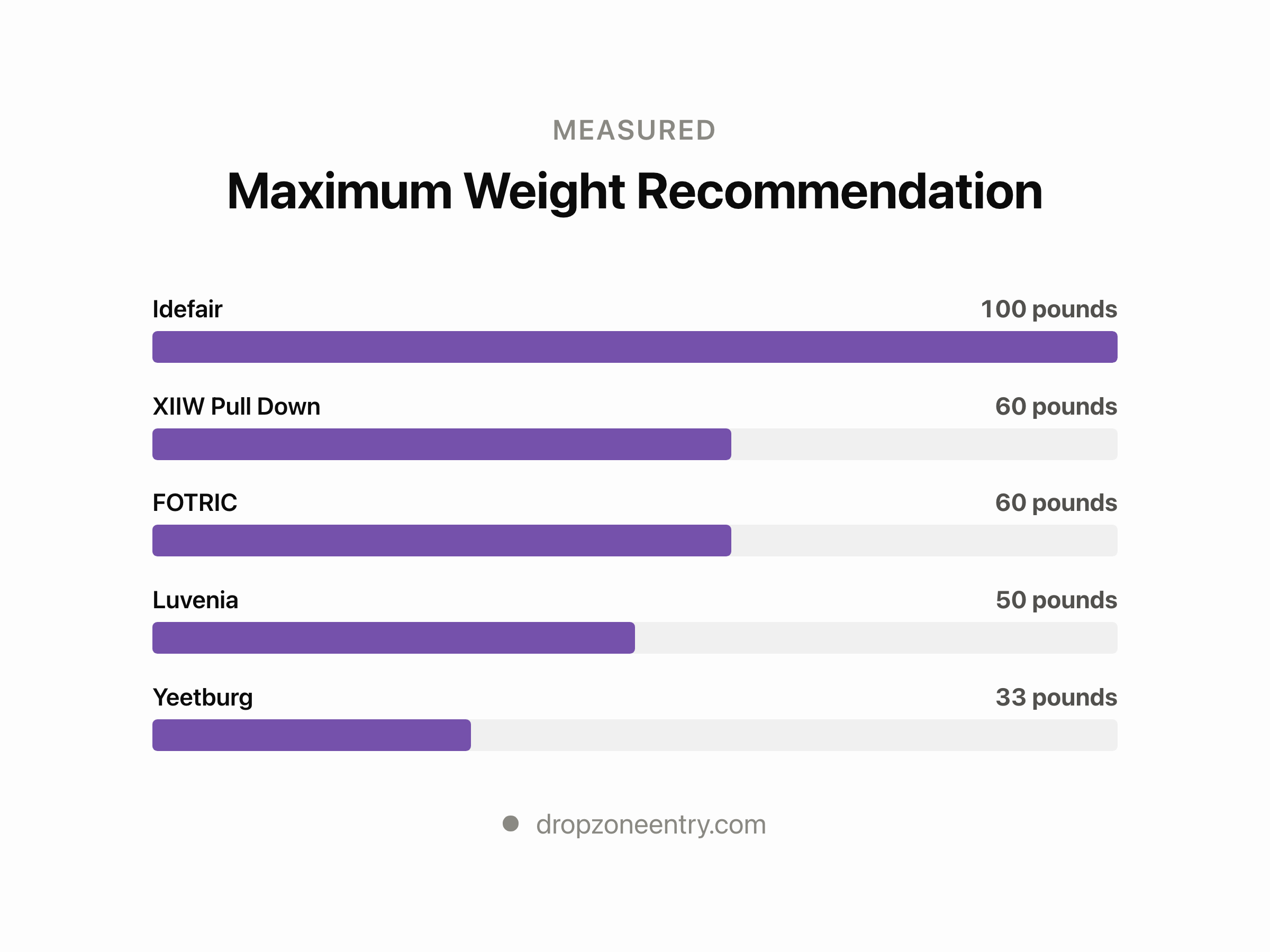
One caveat on the ABtool Closet Rod: rated to only 25 pounds, which is thin for a closet full of wool and winter coats
Published standard against installed practice
One contractor on a Fine Homebuilding thread from August 1, 2005 puts every single rod at 70 inches, saying flatly that 68 is too low and 72 is too high. Another caps his at 68, for one reason: any higher and you cannot lift a box onto the shelf above it.
Both are talking about the same closet. Neither is using 66.
Homeaglow's guide gives the published figure as roughly 66 inches from the floor to the centre of the rod. The evidence does not say where that figure came from or when it was set.
A third voice in the same discussion inverts the whole measurement. He sets the shelf first, 64 to 66 inches depending on how tall the occupant is, so the person can actually see what is stored on it, which lands the rod a couple of inches below that. Same closet, opposite reference point.
The reconciliation
The table shows two contractors landing on 68 and 70 inches, with the 68-inch cap attributed specifically to loading a box onto the shelf above. No source in the evidence generalises this into a rule, or reports what actually failed at any given height.
What height should a double rod coat closet be?
Cabinetmakers and installers on Fine Homebuilding's forum frequently prefer 42 and 84 inches for double rods over the 40 and 80 inches guides print. They derive the 42-inch figure from garment length: most hanging items drop 36 to 38 inches below the shelf, plus floor clearance and an intermediate shelf. What happens to shirts at 40 inches is not reported in the evidence.
With a 96-inch ceiling, a shelf at 84 inches leaves 12 inches of top-shelf storage, according to the same forum.
Where 42/84 comes from
Fine Homebuilding's contributors say the 42/84 dimension exists because men's suit coats have gotten longer. Whether 40/80 is older, or dated, is not established by any source here, and nobody reports measuring coats against either spacing.
Bob Vila specifies 81¾ inches for the top rod and 40½ for the lower. Taskrabbit gives a flat 40 and 80 from floor to rod centre, then calls the 80-inch bar 'perfect for shirts and blouses,' the opposite of Homeaglow's version, which puts coats and long dresses up top and shirts or folded pants below.
A shelf at 84 inches puts the bar itself near 82, which the Fine Homebuilding thread describes as roughly the 85th to 90th percentile maximum reach; the same thread calls an 84-inch top rod a tough reach for anyone under 5'10". One option for a closet that high is an adjustable or pull-down rail, such as the XIIW Pull Down Closet Rod, which brings the rail down to hand level.
The 60-66 inch contradiction, resolved
Taskrabbit's closet rod guide contradicts itself. The body of the article gives a single rod a flat 66 inches; its own FAQ widens that to 60–66 inches. Both numbers appear on the same page, and neither says which closet the lower end belongs to.
The evidence does not resolve the discrepancy: neither number is tied to a particular closet, and no source explains the 60-inch end of the range.
Homeaglow gives walk-ins 66 to 72 inches and shallower reach-ins 60 to 66. Taskrabbit disagrees outright, arguing reach-ins should keep the standard 40 and 80-inch double rods rather than drop to a lower single. The evidence does not adjudicate between them.
Homeaglow puts kids' hanging bars at 30 to 40 inches; Taskrabbit breaks it down by age, 30–36 inches for ages 3–6 and 40–48 for ages 7–12. Homeaglow says the height rises to about 48 inches by the preteen years to accommodate longer clothing.
How far from the back wall
Depth is the neglected number. Bob Vila tells you to mount the rod at least 12 inches out from the rear wall, and to mark the spot where 12 inches out meets 66 inches up. Homeaglow's body copy says about 24 inches from the back wall; its own FAQ then says 12 to 14 inches, given a minimum 24-inch depth. Those two figures cannot both be instructions.
The cabinetmakers work tighter. One poster on WOODWEB's cabinetmaking forum sets rods roughly 10¾ inches off the back wall, using system holes 82mm in from each edge of a 356mm panel; another shop's standard centres the bar 320mm from the back of the end panel.
The figures are not reconciled by any source here. The 12-inch and 24-inch numbers may be measuring different things, centreline versus usable closet depth, but no source says so, and the 10¾-inch figure is a cabinet dimension taken from a panel edge rather than from drywall.
None of these sources states how much depth a bulky coat actually needs, or what happens to the door when the bar sits too far forward. Measuring your own bulkiest coat on its actual hanger, at the intended centreline, with the door closed, is the only way to settle it from the evidence available.
Four measurements to take before you drill
Take these four measurements before the drill comes out. Any one of them can override the published figures above.
- Your longest coat, on the hanger you actually use. Hang it, measure shoulder loop to hem. A cabinetmaker on the WOODWEB forum sizes the shelf gap this way rather than by rule, and reports about 990mm from shelf to hem for a coat. Fine Homebuilding puts the typical drop at 36 to 38 inches, which is where 42-inch double-rod spacing comes from.
- Floor clearance under that hem. No source in the evidence specifies a floor clearance figure; sources say only that garments should not brush or bunch on the closet floor. Subtract the coat length plus whatever clearance you need from your ceiling and you have the highest the bar can sit.
- The gap between shelf and rod. Bob Vila calls for at least 2 inches so hangers can be maneuvered on. A WOODWEB cabinetmaker argues 1½ inches of clearance above makes getting a hanger on difficult, while another guide specifies only 1 to 2 inches. Test it with your own hanger before you commit.
- The shortest adult's reach to the resulting shelf. Fine Homebuilding notes an 84-inch top rod is a tough reach for anyone under 5 feet 10 inches. If the shortest person in the house cannot reach it flat-footed, the number is wrong regardless of what any guide says.
If the reach test fails and the ceiling is high, that is the case for a pull-down rail rather than a lower fixed bar.
ABtool Closet Rod — Best permanent install
- Telescopes from 30 to 92 inches, so one rod spans most reach-in coat closets without cutting
- Screw-fixed brackets and screw-locked telescoping joint set the height permanently instead of relying on tension
- But: Rated to only 25 pounds, which is thin for a closet full of wool and winter coats
- But: Requires drilling into the closet walls, ruling it out for most rentals
XIIW Pull Down — Best high reach
- Pulls the rod down to hand level, so the mounting height no longer limits who can use it
- Pneumatic dual buffer and soft-close damper on both directions of travel
- But: Fixed 33 in drop height, so it only suits closets deep and tall enough to swallow the mechanism
- But: Heaviest option here at about 6.31 kg, requiring solid mounting substrate
Idefair — Best custom sizing
- Stepless width adjustment from 16 to 48 inches, so it isn't limited to preset notches
- Seven vertical settings from 15 to 39 inches, the widest height range in this group
- But: No stated weight rating, so heavy coat loads are a guess
- But: Threaded joint must be fully tightened before loading or capacity is compromised
FOTRIC — Best for two tiers
- Offered in 17-28 in, 17-40 in and 17-52 in length ranges
- Vertical adjustment within a 37 in range for deep drops
- But: The 17-52 in span is a separate purchase, not an adjustment of this unit
- But: Tension-mounted, so it depends on an existing rod above
Deco Brothers — Best for renters
- Seven spring width positions from 18.75 to 30.5 inches click into place with no tools
- Height adjusts in 1-inch increments, finer than most stepped rivals, for precise coat clearance
- But: Maximum 30.5 inch width leaves wide coat closets uncovered
- But: 30 lb ceiling is modest for a full row of heavy coats
Yeetburg — Best hook-hung
- Ships with hooks for overhead mounting rather than requiring an existing rod
- Height adjusts 21.6 to 33 inches over five steps, width 17 to 30 inches, tool-free
- But: Supports about 33 lbs at the centre of the bar, so weight has to be spread
- But: 30-inch maximum width limits it to narrow or single-side closets
Luvenia — Best for kids
- Six height settings between 16.7 and 28.7 in
- 50 lb rating on chrome steel, at about 0.32 kg
- But: Single unit only, so a wide closet needs two
- But: Maximum 28.7 in drop is short for full-length coats above
INFLATION — Best narrow closet
- 15 to 25 inch width suits slim closets and nooks other extenders overshoot
- Extends to 35 inches of drop, deep enough for folded trousers below hanging coats
- But: 15 pound limit is the lowest here and rules out heavy coats
- But: 25-inch maximum width is too narrow for a standard reach-in span
Which of these eight rods fits which closet
Fine Homebuilding's contributors say a rod at or near 82 inches sits at roughly the 85th to 90th percentile maximum reach, and that an 84-inch top bar is a tough reach for anyone under 5'10". No source quantifies the reach of a 5'4" adult, or says what such a household should do instead.
The same four criteria sort all eight of these products:
- the height range they can actually hold
- the span they cover
- the rated load
- whether they need a drill, an existing bar, or an overhead fixing
Height first, span second
Only one option here removes the reach problem outright. The swing-down approach Fine Homebuilding contributors describe stores the bar at about 106 inches and rotates it down and out for access at roughly 68 to 70 inches. XIIW's published specification for its pull-down model is not covered by the evidence file.
So which closet is it for? The tall one, where the shelf and the bar both sit above comfortable reach, and the XIIW pull-down closet rod is the only unit here that does it. The evidence file gives no weight or substrate requirement for it.
The evidence file contains no product specifications for the remaining eight, and no source states a load figure for a full row of coats.
Children's heights
Bob Vila puts the lower bar of a child's double-rod closet at 30 inches above the floor to keep outfits within reach, and Homeaglow says the height rises to about 48 inches by the preteen years. The evidence file carries no specifications for the individual products named above, so their spans and load ratings cannot be verified here.
Measure the reach of the shortest person who uses the closet, subtract, then pick the hardware. Note too that none of the evidence behind this article includes anyone reporting what happened after installation.
Questions
How high should the rod be in a coat closet?
Published guides give 66 inches from the floor, but contractors on Fine Homebuilding report setting single rods at 68 to 72 inches. One installer uses 70, calling 68 too low and 72 too high; another caps his at 68 because higher makes it awkward to lift a box onto the shelf above.
What height should a double rod coat closet be?
Guides print 40 and 80 inches, while cabinetmakers and installers often prefer 42 and 84 inches. The 42-inch gap comes from garment length: most hanging items drop 36 to 38 inches below the shelf, plus floor clearance and an intermediate shelf. Bob Vila specifies 81¾ and 40½ inches.
How far from the back wall should a closet rod be?
Bob Vila says mount the rod at least 12 inches out from the rear wall. Homeaglow's body copy says about 24 inches, its FAQ 12 to 14 inches given a 24-inch minimum depth. Cabinetmakers work tighter, roughly 10¾ inches or 320mm from the panel back.
Is 84 inches too high for a closet rod?
A shelf at 84 inches puts the bar near 82, which Fine Homebuilding contributors describe as roughly the 85th to 90th percentile maximum reach. The same thread calls an 84-inch top rod a tough reach for anyone under 5'10". If the shortest adult can't reach it flat-footed, use a pull-down rail.
How high should a closet rod be for kids?
Homeaglow puts children's hanging bars at 30 to 40 inches, rising to about 48 inches by the preteen years for longer clothing. Taskrabbit breaks it down by age: 30 to 36 inches for ages 3 to 6, and 40 to 48 inches for ages 7 to 12.
Sources
- Closet rod height guide for better access and more storage | Homeaglow accessed 2026-08-04
- The Perfect Closet Rod Height for Hanging Clothes accessed 2026-08-04
- Closet rod height - Fine Homebuilding accessed 2026-08-04
- Here's the Right Shelf and Closet Rod Height - Taskrabbit Skip to content accessed 2026-08-04
- Closet rod layout - WOODWEB's Cabinetmaking Forum accessed 2026-08-04